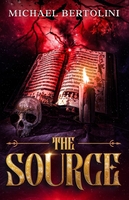

The Source by Michael Bertolini, with commentary by Alan Dark, is available for PRE-ORDER right now from Smashwords, link below. It is a Horror Thriller with some clear nods to H.P. Lovecraft and the wider Cthulhu Mythos while maintaining its own feel. Be sure to check it out, the E-Book will be available on July 1st, 2026 while the Print book will be available for purchase July 4th, 2026.
Also, if you pre-order the e-book RIGHT NOW from Smashwords the price is only $2.99, but if you wait, the price will increase to $3.99 in June and $4.99 once it releases in July.

👉 Pre-Order THE SOURCE on Smashwords 👈
1. Your Book Is Not You
M Presents Publishing doesn't publish children's books, but that doesn't mean the market doesn't exist for them. To that end, I wish to share an email I just received from Authors Publish regarding a course that they're offering. I haven't personally looked into it and space is limited, but I wouldn't want to deprive anyone interested from at least checking it out:
Want to write and publish kids books -- with guidance from a successful author? You are invited to participate in Writing for Young Readers with John Claude Bemis.
This course is for writers who want to explore the art and craft of writing children's books, get expert guidance on the publication process, and personal feedback on your writing.
John knows the industry: He's a successful children's book author, with books published by Penguin and Disney. Plus, he's an award winning teacher who is very skilled at sharing his knowledge.
This course is specifically designed for writers who want to work on books for children, including picture books, chapter books, and middle grade books.
Enrollment in this course is strictly limited to just 22 students.
If you’re thinking about enrolling, I encourage you to learn more right away.
So what is the balance, and how does one go about finding it? Let's look at both showing and telling separately, determining what each does well, before figuring out how to find that optimum balance.
One problem for inexperienced fiction writers—particularly those for whom “show, don't tell" has become ingrained—is that they want to overcompensate by showing everything they possibly can. They show every mundane and unimportant movement, every fidget, every gesture, to the point where characters look like a collection of tics rather than people.
Effective showing is selective showing—finding just the right action or movement or moment that conveys what it is we want the reader not just to understand but to experience, identify with, recognize, and feel.
Consider this: you're going to write about a man uncomfortable on a date—let's say a first date—through showing. What kinds of actions or mannerisms would reveal this particular brand of discomfort? How would you convey first-date jitters through description of behaviors and small actions? Maybe absentmindedly beating Morse code with his fork on his plate? Or shaking his leg nervously so that the table shook and ice against the water glasses chimed? It's about showing us selectively and with focus in order to create a specific understanding of the characters and the scene.
One can accomplish a good bit about a character or situation by telling us something in a way that still makes us puzzle and think-for example, we know precisely what a writer means when we're given a line such as: “She was beautiful." The problem with such direct telling, though, comes from the fact that we do know precisely what it means. The line is nothing less or more than what it appears to be, and thus we simply shrug and accept it. But what about a line like the following: “She was so beautiful that men often seemed mad at her." What does that mean, exactly? How beautiful is someone in order to simultaneously attract and repel suitors? This line is pure telling, but it's also complex and intriguing. When we come to a line like this, we don't simply shrug and accept it but have to consider its full meaning and implication.
Effective telling opens up possibility, nuance, and complexity, whereas ineffective telling shuts possibility down.
The full experience of any scene thus comes from a fine balance of showing and telling, both directed toward giving the reader a total picture of the characters and situation. Both showing and telling only go so far to explaining everything to the reader; it is when they work together that your writing shines.
“If I’m just getting started with writing, what are some things I should focus on?”
“What are some of the things I should avoid doing if I actually want to finish my book?”
I've heard questions like this asked before and I’m going to share the three things to focus on if you’re a brand new writer.
The very first thing I want you to focus on is your mindset. And the reason I say this is because believe that mindset is one of the biggest things that can prevent someone from finishing their novel.
So, before you start writing any new novel, whether it’s your first or your third, you need to have the right mindset going into the process. And what do I mean by the “right” mindset? Well, two things really…
First, you need to understand that your first draft is not going to be perfect. No matter how much time you spend thinking about your story, outlining your story, or re-writing those first few pages, it’s never going to equal a perfect first draft.
I remember writing my first book about 20 years ago at this point and I thought: "wow, this is amazing, I'm going to be famous because of this" without thinking that this first draft was likely going to be full of plot holes, inconsistencies, and various errors that later edits took care of. I sent it off to agents and those that got back to me collectively said "first drafts need a little polish". It was horrible but it didn't let it keep me down.
And I know why we have these kinds of expectations—most writers are also readers. And the books we read are very often really, really good. But they turn out this way because they’ve been through multiple drafts, multiple rounds of revisions, and the author has no doubt had feedback from outside sources during at least one point in the process. But we don’t always think about all of that, right? We just see the final product, and then we set out to write a story that looks like the books we read. And that’s not realistic. Eventually, our stories can get there, I promise—but not at first. That’s just the way it goes. So, what is a more healthy mindset? What would I recommend?
The real purpose of your first draft is to discover your story—it’s to discover your characters, your story world, what’s actually going to happen in the plot, the theme or takeaway you want to leave readers with—all of that. Go into your first draft with the goal of discovering your story, and let the process be fun. Because guess what? Writing can actually be fun if you take some of the pressure off yourself, and if you don’t expect yourself to write the perfect first draft.
The second thing I’d like you to focus on is your story’s genre. This is a big problem I face when reading shorts for an anthology but it's something a writer should consider and there is a phrase I'd like to share: Think about genres in two different ways—commercial genres and content genres.
Commercial genres are sales categories that dictate where your book is placed in a bookstore or how it’s sold online. We can consider something like Young Adult Fiction. That would be a section in a bookstore or online, right? But if you set out to write a Young Adult story, what kind of story would you be writing? A YA romance? A YA mystery? A YA thriller? A YA action story set in a fantasy world? It would be really hard to write a Young Adult novel if you don’t know what kind of story you’re actually telling.
And this is where content genres come in. Content genres, such as my own favorite, tell writers what type of content needs to be in a story to satisfy readers of a particular genre. So, in other words, they provide an entire framework that will help you craft a story that works.
Your content genre can tell you:
And that’s a lot of stuff, right? This is why genre is such an important thing to focus on for new writers—it can honestly take so much overwhelm out of the writing process, and in my opinion, it’s an under-utilized and under-appreciated tool.
So, if you’re just starting out, or even if you’re starting a brand new story, figure out the type of story you want to write. What is your story’s content genre? And then use that as the framework to craft your story within. And if a publisher is seeking a specific genre, save everyone the headache of erroneously submitting.
The third thing I’d like you to focus on is learning how to craft a scene. This is another thing that I think we don’t talk enough about in the writing community—and it’s such an important topic!
Each scene, roughly every 1,500 words, needs a beginning, middle, and end; and your character needs to have a goal. They also need the agency to pursue that goal. All of these things are also required to write a story. So, if you can execute all of this on the micro-scene level, you will be much better equipped to tackle them on the global story level.
But beyond practicing writing scenes that work in your own draft, I recommend studying scenes in published novels. So, think about your favorite book, and then think about a few memorable scenes from that book. Go look for the scene structure in those scenes, and pick them apart to figure out what made you like them so much. This exercise will be so invaluable to you.
And the more you study scenes that work, the better you’ll become at identifying the structural elements and the craft elements that make them work. It took a lot of practice when I did this originally, but now, it doesn’t always feel so hard—and it’s almost something we just do instinctually. So, the same thing can and will happen for you if you just dig in and start breaking scenes down one by one.
So, that is the third key area I would focus on if I was just starting out. And, no matter how experienced a writer you are, I think mastering the art of writing a scene is very important.
So, that wraps up the three main areas I would focus on if I was a brand new writer—or if I was coaching a brand new writer, as an editor. Remember that your first draft won't be perfect, know what genre you're writing and write accordingly, and craft good scenes that contribute to an equally good story. Writing can be fun and rewarding if you put the effort in.
Remember that I am a professional editor and look publisher, and I'm here to help take your writing to the next level.
HAPPY HALLOWEEN! Halloween is my favorite time of the year, and this year I ran a Call of Cthulhu (combining the scenarios "Arachnophob...

